Short Fiction · Middle Grade
The Best Big Sister
Carrie took another look at her poster. In the center was a picture of a little boy on a stretcher with burns on his face and arms, and next to him knelt a nurse cleaning his wounds. On the left was an empty space that Carrie wanted to fill now. She took a look around her father’s workshop and saw a bottle of turpentine on the bench. Dad had forbidden her three-year-old brother Alfred from the workshop because the turpentine could cause an explosion. Carrie saw the CAUTION label on the bottle and knew that she had to have it. She peeled it off from the bottle and put it on her poster. Perfect, she thought. Now everyone will know.
Carrie’s teacher loved her poster and gave her an A. When school ended, she ran home to show it to her dad. As she approached her block, however, she was surprised by the sound of sirens. Walking closer, she was horrified to see little Alfred being carried out of the house on a stretcher, his face and arms covered with burns similar to those of the boy on her poster. When her father saw Carrie, he motioned for her to get into his car. They said nothing as they followed the ambulance to the hospital.
Alfred was unconscious for the next three days, and the doctor said his heart stopped beating twice. Carrie and her father went to visit him every day, staying as long as the nurses would allow. On the fourth day, when they went into Alfred’s room, the doctor met them. Alfred had woken up earlier and cried for them. Though Alfred would recover, he would be blind for the rest of his life. Carrie saw her little brother’s closed eyes, eyes that would never see again, and cried.
“It’s all my fault, dad,” she sobbed. “If I hadn’t used the turpentine label for my poster, Alfred wouldn’t be blind now.”
Her father was silent for a moment, but then he walked over to give her a hug. “I wouldn’t have bought that turpentine from the general store if I knew what would happen. But we cannot go back, Carrie. We live in the present. Be the best big sister for Alfred. Encourage him. Help him be independent.”
Carrie put her arms around her father and nodded on his shoulder. “I promise, dad,” she said.
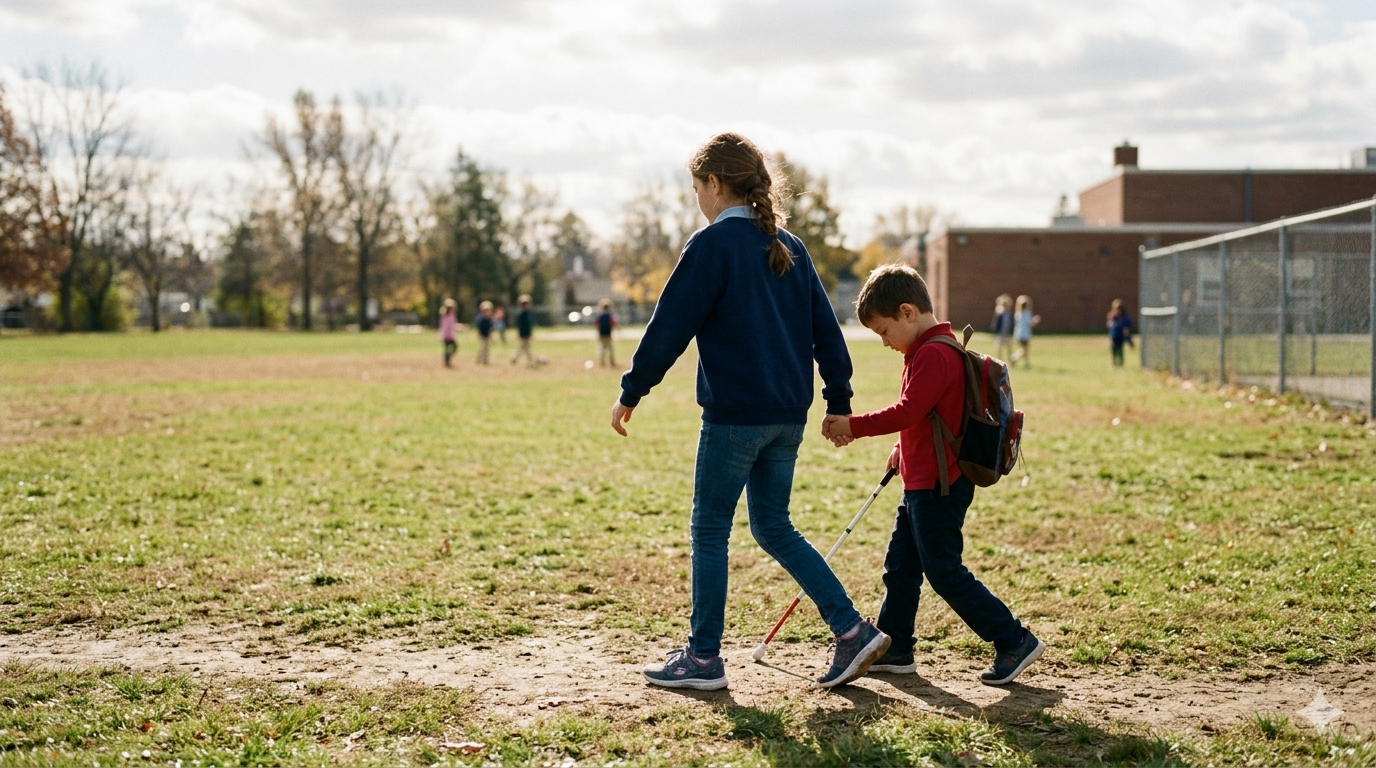
Carrie soon learned how to clean and dress Alfred’s wounds. A lady came to teach Alfred Braille every afternoon, and another man visited once a week to show him how to walk with a long white cane. Carrie asked to learn alongside Alfred, and the teacher agreed. To practice Braille, Carrie would put labels on Alfred’s clothes to identify their color, read books with her brother, and teach it to her friends at school. She encouraged Alfred to use his cane to walk by himself as much as possible—on the playground, at church, at his preschool. Alfred learned quickly, but Carrie always stayed a step ahead, ready for his next challenge.
Three busy years passed, and Alfred was now in the first grade while Carrie started sixth. One day, Carrie found her brother unusually quiet when she picked him up from class. Yet she held her curiosity until they got home. “How was school today, Alfred?” Carrie finally asked, when they had put down their backpacks and were sitting on the couch.
Alfred burst out crying. “It was horrible, Carrie,” he sobbed. “I was running around with my cane and bumped into Angela. I didn’t know she was drinking soda and it spilled all over her favorite dress. She said she won’t talk to me ever again!”
“Did you tell her that you were sorry?”
“No. She said she wouldn’t talk to me.”
“Angela is your best friend. If you tell her you were sorry, maybe she will forgive you.”
“How do I do that? Do I just go up to her and say sorry?” Alfred asked in a small voice.
“Yes. I will help you find her tomorrow, and you can tell her you are sorry you spilled her soda and ruined her dress—and you will be more careful next time.”
The next day, Carrie brought Alfred to Angela. He apologized to her, using the words they practiced. Angela forgave him. Carrie stood behind them, smiling.
On the day before Christmas break, Carrie was with her friends on the field when she heard Alfred shouting, “I’m not scared!”
“Then climb with us,” one boy taunted. “I bet you’re too scared to even put your foot on the first rail.”
Lifting his foot, Alfred was about to hook it into the gap between two bars when Carrie cried, “Alfred, stop!”
Alfred hesitated, and the two boys laughed. “I knew it,” one said. “Little brother is too scared of big sister!”
“No,” Alfred spun around and shot back at Carrie. “If I weren’t blind, I would be on the other side already. It was all your fault, Carrie!”
Carrie froze. Her hands hung in midair, her face white as chalk. He knew, she thought, and he was right. It was all her fault that Alfred was blind.
The fence shook slightly as the other two boys started climbing. Alfred, feeling the movement, turned around and put his feet on the bottom rail. Then he climbed steadily, hand over hand. Above him, the fence ended in sharp, upward-curving spikes like a wolf’s teeth, ready to tear. Carrie jumped and grabbed Alfred by the waist, pulling him away from the fence. Then, they heard the triumphant whoop of one of the boys, who had made it to the top, turn into a scream as his legs swung over the rail and the teeth did what they were always going to do. Carrie’s friends ran to find a teacher.
Alfred turned toward Carrie and reached for her hand, the same way he had reached for it when he was three, when he was in the hospital, and the world had gone dark. His voice broke when he said it. “I’m sorry, Carrie.” She pulled him close and they held each other.
The bell rang. Carrie took Alfred’s hand and led him across the field to where Angela and the other girls were standing in line. They made a space for him.
On Christmas morning, Carrie woke up early and went downstairs to help decorate the tree. She was surprised to find Alfred already there, putting ornaments on the branches. Recognizing his sister’s footsteps, Alfred stopped what he was doing, took a box from under the tree, and pressed it into Carrie’s hands. “Merry Christmas, Carrie. I have something for you. Open it!”
“But it’s not time yet, Alfred,” Carrie protested.
“Open it, please!” Alfred insisted.
Carrie removed the wrapping and felt bumps. TO THE BEST BIG SISTER IN THE WORLD AND FUTURE NURSE, FROM ALFRED AND DAD. The message was written in Braille and print made tactile with white glue.
Inside the box was a first-aid kit. It contained bandages of various types, a bottle of antiseptic solution, alcohol wipes, ointments and lotions, scissors with blunt tips, tweezers, cotton balls, a thermometer in its case—everything a nurse would need in an emergency. Each item was labeled like the box, in Braille and raised print.
“Now you and I can both see all the letters,” Alfred said. “Do you like it, Carrie?”
“I love it, Alfred,” she said, her voice quivering.
∗ ∗ ∗