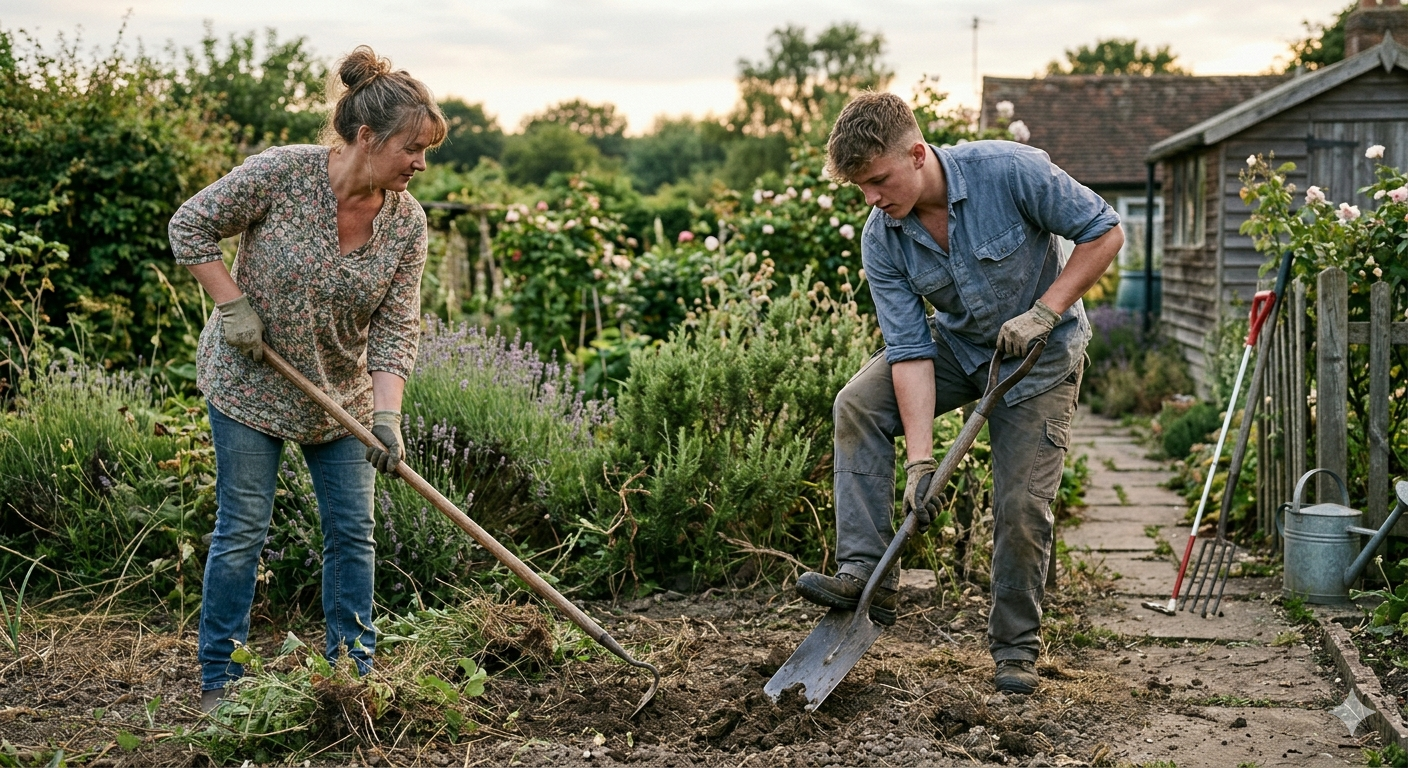
Alfred pressed his hands against the cold metal bars of the garden gate. Inside, his father’s rake scraped the earth in slow, deliberate strokes.
“Dad, can I help pull weeds? I promise I won’t step on anything.”
The rake went silent. “Don’t touch anything in this garden,” his father said. “Last time you pulled up every daffodil and left the thorns standing. Go inside.”
“Alfred and I can weed together,” his sister Carrie offered. “I’ll tell him which ones are flowers.”
“The garden isn’t safe for your brother.” His father’s voice was not unkind, which made it worse. “He could get stabbed, trip on the rocks, get lost. Best run along, Alfred.”
Alfred took out his white cane and hit the gate hard on his way out. Inside the house he slammed the door and slapped the hot tears from his face before they could fall.
“Let us rise and sing Safe in the Arms of Jesus.”
The pastor’s voice brought Alfred back to the present. He rose with the others and sang with all his heart. Despite everything, he had loved his father. He was glad the old man’s suffering was over.
After the service Alfred and Carrie stood shaking hands until the last mourner had gone. At the graveside Alfred thanked his father for loving them the only way he knew how, and promised to help keep the garden from going to ruin. A week later they visited the garden he had tended for thirty years.
“Do you want me to guide you, or go in alone?” Carrie asked. “Everything is in neat rows. But some plants have thorns, and others are poisonous.”
“I’ll go in myself,” Alfred said. Carrie placed the key in his hand.
For the first time, Alfred walked into his father’s garden. He moved down each aisle, cane finding the stone path, stopping often — for the dense sweetness of roses, lavender’s drier fragrance, the waxy intoxicating smell of gardenia that made him crouch and feel the thick cool petals with both palms. He laughed when he found lamb’s ear, pressing its impossibly soft leaves against his cheek. A faint rustling drew him to ornamental grasses, their arching blades swaying like silk ribbons. Only the woody scent of rosemary told him the warmth had left the sun. He had been inside for hours.
“There were so many plants to smell and touch and listen to,” he told Carrie over potato soup that evening. “I wish more people could experience such loveliness.”
“So what do you want to do?”
“Make this garden a place where everyone could hear and smell and touch nature’s beauty.” He paused. “But I’ve never done any gardening, Carrie.”
“I used to help Dad,” she said simply. “I’m there if you need me.”
The next morning she placed a spade in his hands and taught him to feel the resistance of soil with his body rather than his eyes, then moved him through the rake and the hoe. “If you forget everything else,” she said, “remember: the spade opens the ground, the rake refines it, the hoe maintains it.” That evening she pressed into his hands something else — braille notes on every plant in the garden, written over three days without telling him.
Alfred spent the following week designing. The fence would be covered in honeysuckle. Rosemary hedges would line both sides of the stone path. Lavender edging would signal visitors to slow down near the beds. At the caution zones he chose lamb’s ear as the boundary — its unmistakable velvet a warning that required no words.
One evening while weeding he cut a stem that released thick milky sap. The burning began before he could put down his tools. He washed his hands until Carrie came home, took over, wrapped them in cold cloth, and applied calamine lotion with the quiet efficiency of someone who had always tended his wounds. She said nothing about the garden. When he was healed she handed him gardening gloves without a word.
Three months later he discovered monkshood at the local nursery — tall spikes of deep purple hooded flowers, complex and architectural under his gloved fingers. He worked with it all afternoon, not knowing the gloves were torn at the fingertips from weeks of use. The tingling began that evening, spread from his fingers up his arms to his chest. By morning he could not rise. Carrie sat beside him through two anxious weeks until the doctor’s grave face confirmed what she already feared.
On the first morning he could sit up, Alfred found Carrie’s braille notes on the bedside table. Monkshood on top. His sister believed in him. But if his father — a master gardener — had never conceived of such a place, who was he, an amateur poisoned twice, to bring it to life? He put the tools away in the shed.
The camp for visually impaired children sat in open country, and Alfred loved it from the first morning. He taught the children to identify birds by song, to follow a path with their canes, to find pineapple weed along the path edges and press it between their fingers in delight. He played ukulele at campfires, told stories, led search parties whenever a camper wandered. He slept soundly and rose eager. After three summers he was promoted to assistant director, and the first change he made was to organize a visit to a private estate garden. The director assured him nothing was poisonous. Alfred was so moved by the rare invitation that when the director suggested he preview the grounds first, he declined. He wanted to be surprised alongside the children.
The garden was beautiful. Fragrance drifted between the beds and the children moved through it with open hands and open faces. “Children,” Alfred said, “feel free to explore. I want to hear every new scent you discover.”
Martin had a particular allergy. His mother always checked new environments first, a habit that embarrassed him. Alfred had said to explore, and he was going to enjoy himself for once. He touched and sniffed everything until he felt the bumps rising on his arms and knew. “Mr. Alfred,” he called, his voice shaking.
Alfred felt the boy’s arms and burning forehead and forced himself calm. The camp nurse called an ambulance. As it pulled away he gathered the children and led them back.
He called Martin’s mother that night. No one answered. He called the next day, and every day after. The unanswered phone was worse than confrontation — a man on death row who never learned his sentence.
The camp director thanked him for three years of dedication and told him they could not retain him. Alfred said thank you in a voice he did not recognize and walked out before the tears reached his face.
Carrie drove him home. Alfred sat with her braille notes in his hands and thought about gates — his father’s, the campground’s, the ones he kept shutting on himself. He had spent his life pressing his hands against locked bars, and when he finally threw every gate open he had nearly killed a boy.
He went to see how the garden was doing. Weeds had taken the beds. Some of his early plantings had died, leaving bare patches in the soil. He crouched beside the dead section and stayed there a long time, hands reading the ground. His first plantings were dead. His first directorship was dead. But the garden was not dead. He was not dead. He was only tired — tired of locked gates.
He heard Carrie’s footsteps. She did not speak. She opened the shed, took out a hoe, and began clearing dead growth beside him — pulling weeds, making space, working with the steady patience she had always brought to every ruined thing in his life. After a long moment Alfred stood, went to the shed, and came back with a spade. He crouched next to her and began.
They worked until Carrie’s stomach rumbled.
“Spaghetti and meatballs,” Alfred said.
“Sounds perfect,” she said, and her stomach rumbled again.
Over the following months Carrie brought home seed packets and potted plants each evening, and Alfred spent his days planting, watering, and weeding. By spring the beds were fragrant with blossoms. He found work at a call center and discovered a gift for sales. On coworkers’ birthdays he brought fruit or potted plants from the garden, always received with more warmth than he expected.
One evening over shepherd’s pie Carrie said, “Alfred, I think your garden is ready for the world.”
He was quiet. He had thought of the garden only as his — a gate finally open after a lifetime outside. But perhaps a gate open to one person could be opened wider.
“Do you think anyone would come?”
“I think we have made this garden welcoming to people of every ability,” Carrie said. “All we need are signs — which plants to touch freely, which to approach with care, which are poisonous, which cause allergies. It’s almost your birthday. What better way to mark a year of hard work?”
For three weeks they made signs after work — braille and print, mounted at hand height, each carrying the plant’s name, a raised tracing of its texture in dried glue, a scent description, a safe-to-touch indication, allergy warnings, and a DO NOT INGEST notice where needed. The entrance bore a tactile map of the garden paths. The welcome statement took Alfred two days to write:
We welcome you to explore at your own pace and in your own way. Please read each sign before you touch or smell. Use caution if you have special allergies, and never eat what is not meant to be eaten.
On Alfred’s birthday they opened the gate.
Carrie sold seeds at the entrance while Alfred led children through tours he had designed — pausing at each plant to show them how to approach it on its own terms. Roses, he told them, have thorns because they prefer to be smelled and admired rather than handled. Apple blossoms are welcoming because the tree wants you to carry the seeds away so more apple trees can grow. Every plant has a personality, he said, and the art is learning to listen for it.
A boy arrived with his mother and went straight to Carrie’s table, picking up seed packets and asking rapid questions — dragonfruit, lavender, can you grow this in a pot? Carrie answered everything with a smile. When the boy and his mother turned to join the tour, Carrie looked up and recognition arrived like a quiet blow — the boy’s profile, his particular way of holding his head. Martin.
His mother saw Carrie’s face and smiled.
Carrie smiled back, watching Martin reach out and touch the first sign on the path — his fingers moving carefully over the braille, reading, learning the name of what he was about to meet — and felt, more than anything else, proud of her brother for building a garden where a boy like Martin could finally touch everything safely, freely, and without fear.