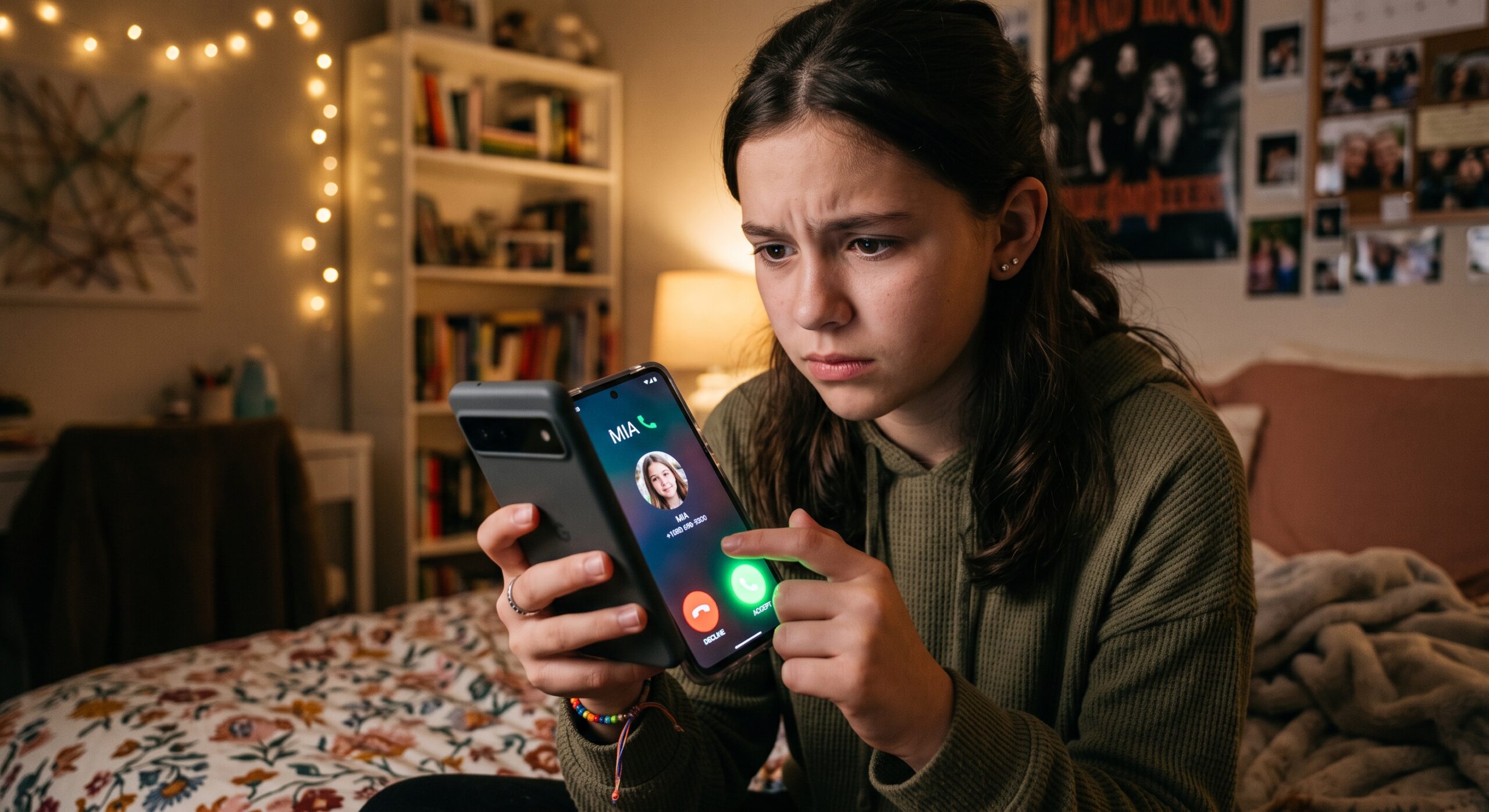
Della took the last sweater from her suitcase and pushed it onto the floor, where it landed with a thunk. It was 9:00 PM on the seventh day since they moved. The hallways in her new school had never felt so long. At least Della was done unpacking.
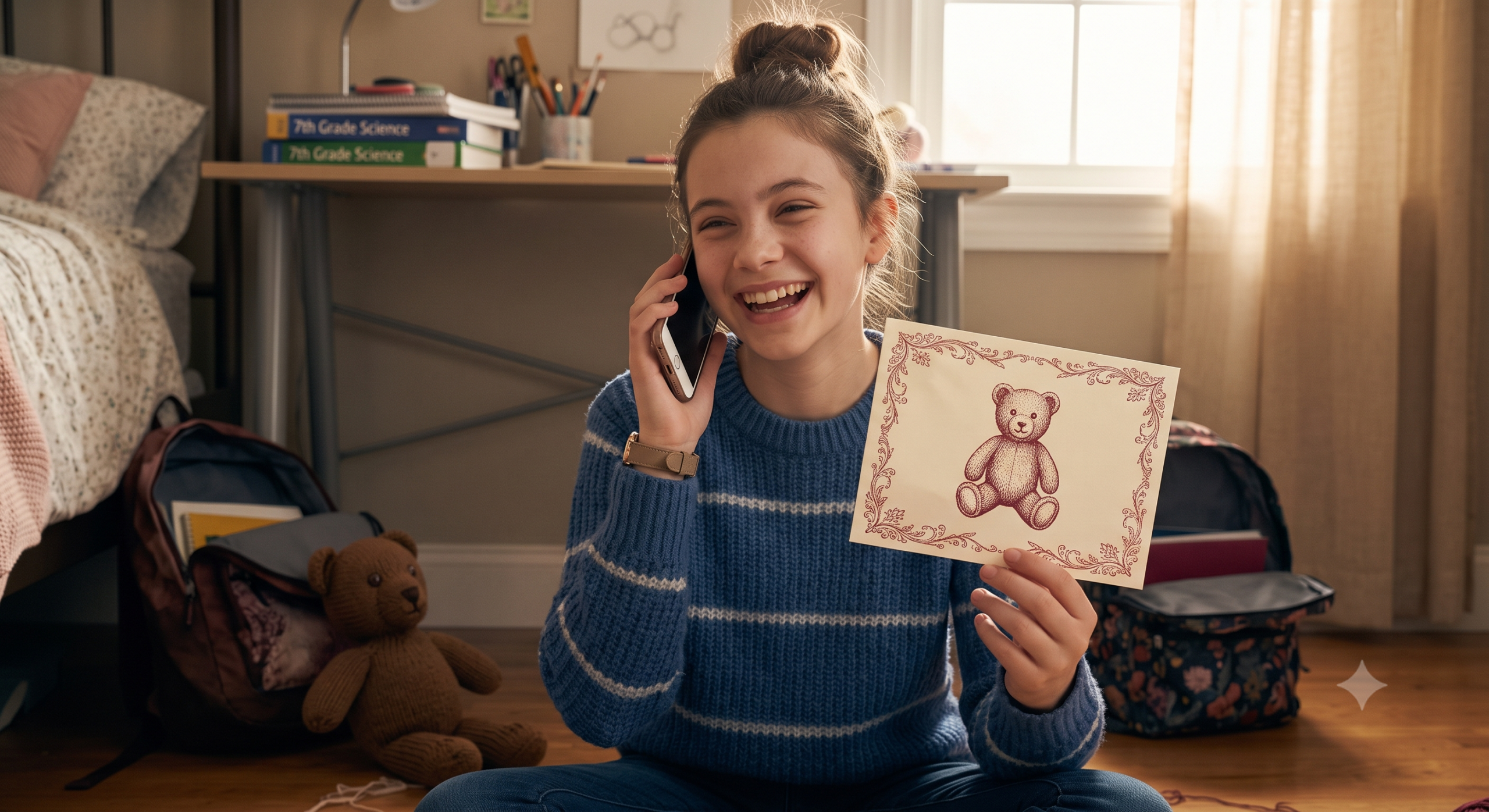
She was about to get up to get ready for bed when a hole on the floor, where her suitcase had loosened a floorboard, caught her attention. Inside was an envelope with the handwriting of her best friend Sage. The letters were all the same size, written with Sage’s favorite burgundy pen. The envelope was styled with the decorative border Sage drew on the covers of all her notebooks, and in the middle was the drawing of a teddy bear.
Sage and Della had an unlikely friendship. Whereas Sage was quiet and artistic, Della was outgoing and athletic. They met at recess during the first day of fifth grade, when Sage had just moved to their town. Della had seen Sage sitting alone on a bench, knitting a bear. Della loved teddy bears and had always wanted to learn to knit. She went over to Sage and said, “Your bear looks so cute. Can you teach me how to knit something?”
Sage agreed. After three months of hard work, Della made a scarf for her mom for Christmas. Della had always been so clumsy with fine art that her mom had never bothered to teach her how to knit.
Della took Sage’s knitted bear from her dresser. Sage had left it in Della’s suitcase without telling her. The bear matched the picture exactly, right down to the rounded ears. It was just like Sage to memorize and reproduce something with every detail in place. Yet, why would Sage give Della the bear after what Della had said to her?
On the last day of sixth grade, Della had made goodbye cards for all her friends and passed them out. Since Sage was her best friend, Della thought she would make her card extra-special by including a $20 gift card to the local fabric store. Yet Sage would not even open her card. Instead, she said, “It must be nice to just get up and move whenever you want, huh?”
Della was so excited about joining the soccer team and the drama club in her new school that she missed the sarcasm in Sage’s voice. Instead, she rattled off all the things she was looking forward to doing next year, adding, “And you can come visit whenever you want, Sage. My address is 4210 Tulane Road.”
For a split second Della thought Sage’s face had gone pale. Yet, before she could say anything, Sage had thrown her card into the trash.
Della was hurt. “Never mind. You don’t have to come visit. You are not invited anyway!”
Della opened the envelope and found a letter inside.
Dear Jeff,
I don’t know where you are now, but I want to leave this letter here in case you come back. Mom and Dad thought our house was too sad to live in after you were gone, so we are moving. I didn’t have time to finish knitting the bear that I wanted to leave with you, so a picture will have to do for now. You were my brother and best friend. I don’t even know who I will give the bear to when I finish making it.
Love, Sage
Della was still for a long moment as she absorbed everything she just learned. Sage had a brother. And her brother was gone.
Della grabbed her cell phone and called Sage. Sage picked up on the first ring, and both girls started talking at once.
“I’m sorry, Sage,” Della said. “I shouldn’t have said what I said. You are still my best friend. Please come visit me anytime.”
On the other end, Sage was saying, “I’m sorry I threw away your card, Della. I got it back from the trash and it’s great. I can take a picture and show you that I really have it.”
Della and Sage finished their apologies at the same time, and neither girl really heard what the other said. After a moment of silence, the girls laughed.
Carrie took another look at her poster. In the center was a picture of a little boy on a stretcher with burns on his face and arms, and next to him knelt a nurse cleaning his wounds. On the left was an empty space that Carrie wanted to fill now. She took a look around her father’s workshop and saw a bottle of turpentine on the bench. Dad had forbidden her three-year-old brother Alfred from the workshop because the turpentine could cause an explosion. Carrie saw the CAUTION label on the bottle and knew that she had to have it. She peeled it off from the bottle and put it on her poster. Perfect, she thought. Now everyone will know.
Carrie’s teacher loved her poster and gave her an A. When school ended, she ran home to show it to her dad. As she approached her block, however, she was surprised by the sound of sirens. Walking closer, she was horrified to see little Alfred being carried out of the house on a stretcher, his face and arms covered with burns similar to those of the boy on her poster. When her father saw Carrie, he motioned for her to get into his car. They said nothing as they followed the ambulance to the hospital.
Alfred was unconscious for the next three days, and the doctor said his heart stopped beating twice. Carrie and her father went to visit him every day, staying as long as the nurses would allow. On the fourth day, when they went into Alfred’s room, the doctor met them. Alfred had woken up earlier and cried for them. Though Alfred would recover, he would be blind for the rest of his life. Carrie saw her little brother’s closed eyes, eyes that would never see again, and cried.
“It’s all my fault, dad,” she sobbed. “If I hadn’t used the turpentine label for my poster, Alfred wouldn’t be blind now.”
Her father was silent for a moment, but then he walked over to give her a hug. “I wouldn’t have bought that turpentine from the general store if I knew what would happen. But we cannot go back, Carrie. We live in the present. Be the best big sister for Alfred. Encourage him. Help him be independent.”
Carrie put her arms around her father and nodded on his shoulder. “I promise, dad,” she said.
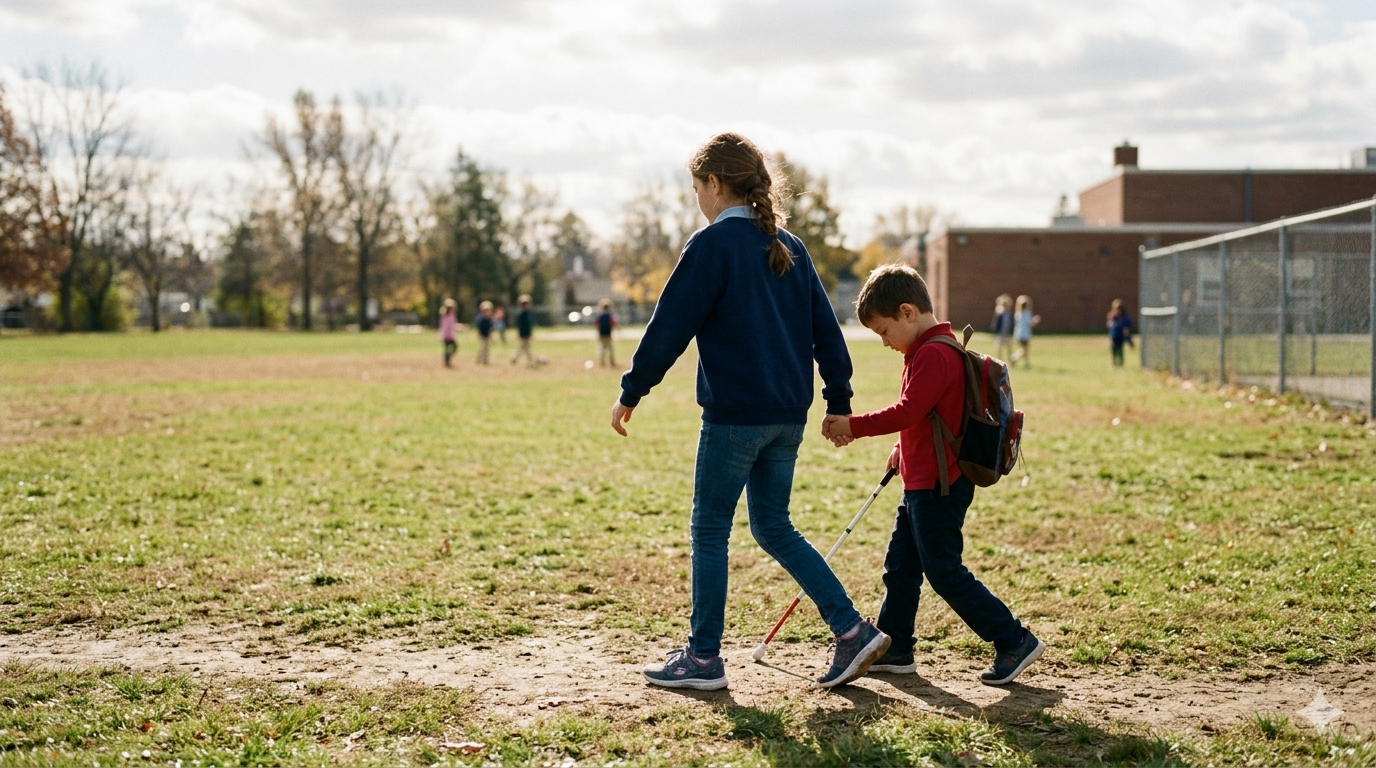
Carrie soon learned how to clean and dress Alfred’s wounds. A lady came to teach Alfred Braille every afternoon, and another man visited once a week to show him how to walk with a long white cane. Carrie asked to learn alongside Alfred, and the teacher agreed. To practice Braille, Carrie would put labels on Alfred’s clothes to identify their color, read books with her brother, and teach it to her friends at school. She encouraged Alfred to use his cane to walk by himself as much as possible—on the playground, at church, at his preschool. Alfred learned quickly, but Carrie always stayed a step ahead, ready for his next challenge.
Three busy years passed, and Alfred was now in the first grade while Carrie started sixth. One day, Carrie found her brother unusually quiet when she picked him up from class. Yet she held her curiosity until they got home. “How was school today, Alfred?” Carrie finally asked, when they had put down their backpacks and were sitting on the couch.
Alfred burst out crying. “It was horrible, Carrie,” he sobbed. “I was running around with my cane and bumped into Angela. I didn’t know she was drinking soda and it spilled all over her favorite dress. She said she won’t talk to me ever again!”
“Did you tell her that you were sorry?”
“No. She said she wouldn’t talk to me.”
“Angela is your best friend. If you tell her you were sorry, maybe she will forgive you.”
“How do I do that? Do I just go up to her and say sorry?” Alfred asked in a small voice.
“Yes. I will help you find her tomorrow, and you can tell her you are sorry you spilled her soda and ruined her dress—and you will be more careful next time.”
The next day, Carrie brought Alfred to Angela. He apologized to her, using the words they practiced. Angela forgave him. Carrie stood behind them, smiling.
On the day before Christmas break, Carrie was with her friends on the field when she heard Alfred shouting, “I’m not scared!”
“Then climb with us,” one boy taunted. “I bet you’re too scared to even put your foot on the first rail.”
Lifting his foot, Alfred was about to hook it into the gap between two bars when Carrie cried, “Alfred, stop!”
Alfred hesitated, and the two boys laughed. “I knew it,” one said. “Little brother is too scared of big sister!”
“No,” Alfred spun around and shot back at Carrie. “If I weren’t blind, I would be on the other side already. It was all your fault, Carrie!”
Carrie froze. Her hands hung in midair, her face white as chalk. He knew, she thought, and he was right. It was all her fault that Alfred was blind.
The fence shook slightly as the other two boys started climbing. Alfred, feeling the movement, turned around and put his feet on the bottom rail. Then he climbed steadily, hand over hand. Above him, the fence ended in sharp, upward-curving spikes like a wolf’s teeth, ready to tear. Carrie jumped and grabbed Alfred by the waist, pulling him away from the fence. Then, they heard the triumphant whoop of one of the boys, who had made it to the top, turn into a scream as his legs swung over the rail and the teeth did what they were always going to do. Carrie’s friends ran to find a teacher.
Alfred turned toward Carrie and reached for her hand, the same way he had reached for it when he was three, when he was in the hospital, and the world had gone dark. His voice broke when he said it. “I’m sorry, Carrie.” She pulled him close and they held each other.
The bell rang. Carrie took Alfred’s hand and led him across the field to where Angela and the other girls were standing in line. They made a space for him.
On Christmas morning, Carrie woke up early and went downstairs to help decorate the tree. She was surprised to find Alfred already there, putting ornaments on the branches. Recognizing his sister’s footsteps, Alfred stopped what he was doing, took a box from under the tree, and pressed it into Carrie’s hands. “Merry Christmas, Carrie. I have something for you. Open it!”
“But it’s not time yet, Alfred,” Carrie protested.
“Open it, please!” Alfred insisted.
Carrie removed the wrapping and felt bumps. TO THE BEST BIG SISTER IN THE WORLD AND FUTURE NURSE, FROM ALFRED AND DAD. The message was written in Braille and print made tactile with white glue.
Inside the box was a first-aid kit. It contained bandages of various types, a bottle of antiseptic solution, alcohol wipes, ointments and lotions, scissors with blunt tips, tweezers, cotton balls, a thermometer in its case—everything a nurse would need in an emergency. Each item was labeled like the box, in Braille and raised print.
“Now you and I can both see all the letters,” Alfred said. “Do you like it, Carrie?”
“I love it, Alfred,” she said, her voice quivering.
∗ ∗ ∗
Filed under: Short Fiction · Middle Grade · Deadlines for Writers June 2026
Alfred pressed his hands against the cold metal bars of the garden gate. Inside, his father’s rake scraped the earth in slow, deliberate strokes.
“Dad, can I help pull weeds? I promise I won’t step on anything.”
The rake went silent. “Don’t touch anything in this garden,” his father said. “Last time you pulled up every daffodil and left the thorns standing. Go inside.”
“Alfred and I can weed together,” his sister Carrie offered. “I’ll tell him which ones are flowers.”
“The garden isn’t safe for your brother.” His father’s voice was not unkind, which made it worse. “He could get stabbed, trip on the rocks, get lost. Best run along, Alfred.”
Alfred took out his white cane and hit the gate hard on his way out. Inside the house he slammed the door and slapped the hot tears from his face before they could fall.
✦
“Let us rise and sing Safe in the Arms of Jesus.”
The pastor’s voice brought Alfred back to the present. He rose with the others and sang with all his heart. Despite everything, he had loved his father. He was glad the old man’s suffering was over.
After the service Alfred and Carrie stood shaking hands until the last mourner had gone. At the graveside Alfred thanked his father for loving them the only way he knew how, and promised to help keep the garden from going to ruin. A week later they visited the garden he had tended for thirty years.
“Do you want me to guide you, or go in alone?” Carrie asked. “Everything is in neat rows. But some plants have thorns, and others are poisonous.”
“I’ll go in myself,” Alfred said. Carrie placed the key in his hand.
For the first time, Alfred walked into his father’s garden. He moved down each aisle, cane finding the stone path, stopping often — for the dense sweetness of roses, lavender’s drier fragrance, the waxy intoxicating smell of gardenia that made him crouch and feel the thick cool petals with both palms. He laughed when he found lamb’s ear, pressing its impossibly soft leaves against his cheek. A faint rustling drew him to ornamental grasses, their arching blades swaying like silk ribbons. Only the woody scent of rosemary told him the warmth had left the sun. He had been inside for hours.
“There were so many plants to smell and touch and listen to,” he told Carrie over potato soup that evening. “I wish more people could experience such loveliness.”
“So what do you want to do?”
“Make this garden a place where everyone could hear and smell and touch nature’s beauty.” He paused. “But I’ve never done any gardening, Carrie.”
“I used to help Dad,” she said simply. “I’m there if you need me.”
The next morning she placed a spade in his hands and taught him to feel the resistance of soil with his body rather than his eyes, then moved him through the rake and the hoe. “If you forget everything else,” she said, “remember: the spade opens the ground, the rake refines it, the hoe maintains it.” That evening she pressed into his hands something else — braille notes on every plant in the garden, written over three days without telling him.
Alfred spent the following week designing. The fence would be covered in honeysuckle. Rosemary hedges would line both sides of the stone path. Lavender edging would signal visitors to slow down near the beds. At the caution zones he chose lamb’s ear as the boundary — its unmistakable velvet a warning that required no words.
One evening while weeding he cut a stem that released thick milky sap. The burning began before he could put down his tools. He washed his hands until Carrie came home, took over, wrapped them in cold cloth, and applied calamine lotion with the quiet efficiency of someone who had always tended his wounds. She said nothing about the garden. When he was healed she handed him gardening gloves without a word.
Three months later he discovered monkshood at the local nursery — tall spikes of deep purple hooded flowers, complex and architectural under his gloved fingers. He worked with it all afternoon, not knowing the gloves were torn at the fingertips from weeks of use. The tingling began that evening, spread from his fingers up his arms to his chest. By morning he could not rise. Carrie sat beside him through two anxious weeks until the doctor’s grave face confirmed what she already feared.
On the first morning he could sit up, Alfred found Carrie’s braille notes on the bedside table. Monkshood on top. His sister believed in him. But if his father — a master gardener — had never conceived of such a place, who was he, an amateur poisoned twice, to bring it to life? He put the tools away in the shed.
✦
The camp for visually impaired children sat in open country, and Alfred loved it from the first morning. He taught the children to identify birds by song, to follow a path with their canes, to find pineapple weed along the path edges and press it between their fingers in delight. He played ukulele at campfires, told stories, led search parties whenever a camper wandered. He slept soundly and rose eager. After three summers he was promoted to assistant director, and the first change he made was to organize a visit to a private estate garden. The director assured him nothing was poisonous. Alfred was so moved by the rare invitation that when the director suggested he preview the grounds first, he declined. He wanted to be surprised alongside the children.
The garden was beautiful. Fragrance drifted between the beds and the children moved through it with open hands and open faces. “Children,” Alfred said, “feel free to explore. I want to hear every new scent you discover.”
Martin had a particular allergy. His mother always checked new environments first, a habit that embarrassed him. Alfred had said to explore, and he was going to enjoy himself for once. He touched and sniffed everything until he felt the bumps rising on his arms and knew. “Mr. Alfred,” he called, his voice shaking.
Alfred felt the boy’s arms and burning forehead and forced himself calm. The camp nurse called an ambulance. As it pulled away he gathered the children and led them back.
He called Martin’s mother that night. No one answered. He called the next day, and every day after. The unanswered phone was worse than confrontation — a man on death row who never learned his sentence.
The camp director thanked him for three years of dedication and told him they could not retain him. Alfred said thank you in a voice he did not recognize and walked out before the tears reached his face.
✦
Carrie drove him home. Alfred sat with her braille notes in his hands and thought about gates — his father’s, the campground’s, the ones he kept shutting on himself. He had spent his life pressing his hands against locked bars, and when he finally threw every gate open he had nearly killed a boy.
He went to see how the garden was doing. Weeds had taken the beds. Some of his early plantings had died, leaving bare patches in the soil. He crouched beside the dead section and stayed there a long time, hands reading the ground. His first plantings were dead. His first directorship was dead. But the garden was not dead. He was not dead. He was only tired — tired of locked gates.
He heard Carrie’s footsteps. She did not speak. She opened the shed, took out a hoe, and began clearing dead growth beside him — pulling weeds, making space, working with the steady patience she had always brought to every ruined thing in his life. After a long moment Alfred stood, went to the shed, and came back with a spade. He crouched next to her and began.
They worked until Carrie’s stomach rumbled.
“Spaghetti and meatballs,” Alfred said.
“Sounds perfect,” she said, and her stomach rumbled again.
✦
Over the following months Carrie brought home seed packets and potted plants each evening, and Alfred spent his days planting, watering, and weeding. By spring the beds were fragrant with blossoms. He found work at a call center and discovered a gift for sales. On coworkers’ birthdays he brought fruit or potted plants from the garden, always received with more warmth than he expected.
One evening over shepherd’s pie Carrie said, “Alfred, I think your garden is ready for the world.”
He was quiet. He had thought of the garden only as his — a gate finally open after a lifetime outside. But perhaps a gate open to one person could be opened wider.
“Do you think anyone would come?”
“I think we have made this garden welcoming to people of every ability,” Carrie said. “All we need are signs — which plants to touch freely, which to approach with care, which are poisonous, which cause allergies. It’s almost your birthday. What better way to mark a year of hard work?”
For three weeks they made signs after work — braille and print, mounted at hand height, each carrying the plant’s name, a raised tracing of its texture in dried glue, a scent description, a safe-to-touch indication, allergy warnings, and a DO NOT INGEST notice where needed. The entrance bore a tactile map of the garden paths. The welcome statement took Alfred two days to write:
We welcome you to explore at your own pace and in your own way. Please read each sign before you touch or smell. Use caution if you have special allergies, and never eat what is not meant to be eaten.
On Alfred’s birthday they opened the gate.
Carrie sold seeds at the entrance while Alfred led children through tours he had designed — pausing at each plant to show them how to approach it on its own terms. Roses, he told them, have thorns because they prefer to be smelled and admired rather than handled. Apple blossoms are welcoming because the tree wants you to carry the seeds away so more apple trees can grow. Every plant has a personality, he said, and the art is learning to listen for it.
A boy arrived with his mother and went straight to Carrie’s table, picking up seed packets and asking rapid questions — dragonfruit, lavender, can you grow this in a pot? Carrie answered everything with a smile. When the boy and his mother turned to join the tour, Carrie looked up and recognition arrived like a quiet blow — the boy’s profile, his particular way of holding his head. Martin.
His mother saw Carrie’s face and smiled.
Carrie smiled back, watching Martin reach out and touch the first sign on the path — his fingers moving carefully over the braille, reading, learning the name of what he was about to meet — and felt, more than anything else, proud of her brother for building a garden where a boy like Martin could finally touch everything safely, freely, and without fear.
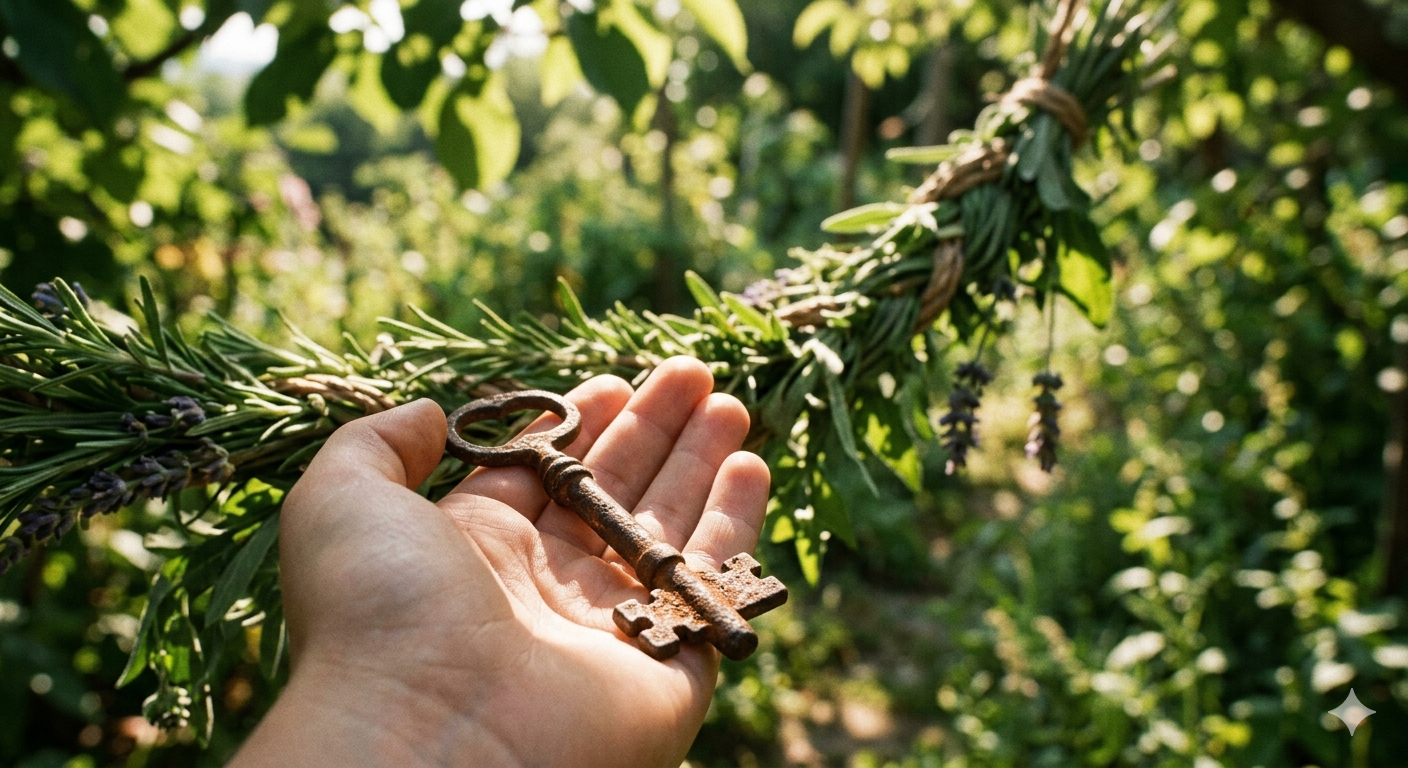
The first morning at Grandma’s house, she gave me an old, rusty key.
“Go outside and explore,” she said.
I did not want to walk around with an old key, but I wanted to cross Grandma even less. So I put the key in my wallet and went outside.
Grandma’s yard had a concrete path with plants lining either side. I took small steps forward, not wanting to stray into the flowerbeds. I was taking the key out to examine it more closely when I stepped on a loose rock. Falling forward, I bumped my head against an old metal gate and sent the wallet flying beneath it. It landed on soil with a thud. I shook the gate and found it locked. I had stumbled upon the garden my great uncle, who was also blind, had crafted.
I felt along the wall for another way in. I found a tree with thick branches stretching beyond the gate into the garden. But when I stepped onto the lowest branch, it snapped and I tumbled to the ground. I dusted myself off and picked up the broken branch, sweeping it in front of me like the long cane I had forgotten to bring. Trailing the gate, I smelled pungent scents and felt leaves tickling my cheek. My hand found a rope of braided herbs. I followed it — but it led me straight back to the cold, locked gate.
The wind picked up, carrying the rustling of leaves and the jingling of wind chimes. One chime sounded more dull than the others. I reached up and found something attached to it with a string — an old, rusty key, not unlike the one inside my wallet. I untied it, trailed back to the gate, and inserted it into the lock. It would not turn.
I sat on the ground and put my head in my hands. Grandma had told me to explore, but I had nowhere to go.
Then I remembered — the broken branch. I thrust it beneath the gate and heard a small tinkle. Slowly, patiently, I nudged my wallet closer until it landed on the concrete beside me with a ding. I took out Grandma’s key and put it in the lock. This time it turned. The gate swung open.
I walked through and closed it behind me.
Standing with my back to the gate, I took a deep breath. The air was fragrant with mint, lavender, rosemary, basil, and other herbs I could not name. Instead of wind chimes, I heard birds singing above me. The braided rope of herbs was right overhead, and by following it I discovered I could travel the whole garden — smelling the flowers, touching the trees, feeling enveloped by warm air and sweet scents like a welcomed guest. No thorns caught my fingers. No bitter smells warned me away. Everything here invited touch.
I held up Grandma’s key in one hand and grasped the braided herbs with the other. My great uncle had crafted this garden for someone like me. And my grandmother, all along, had known exactly where it was.
A story of secrets, Morse code, and the truth hidden in touch.
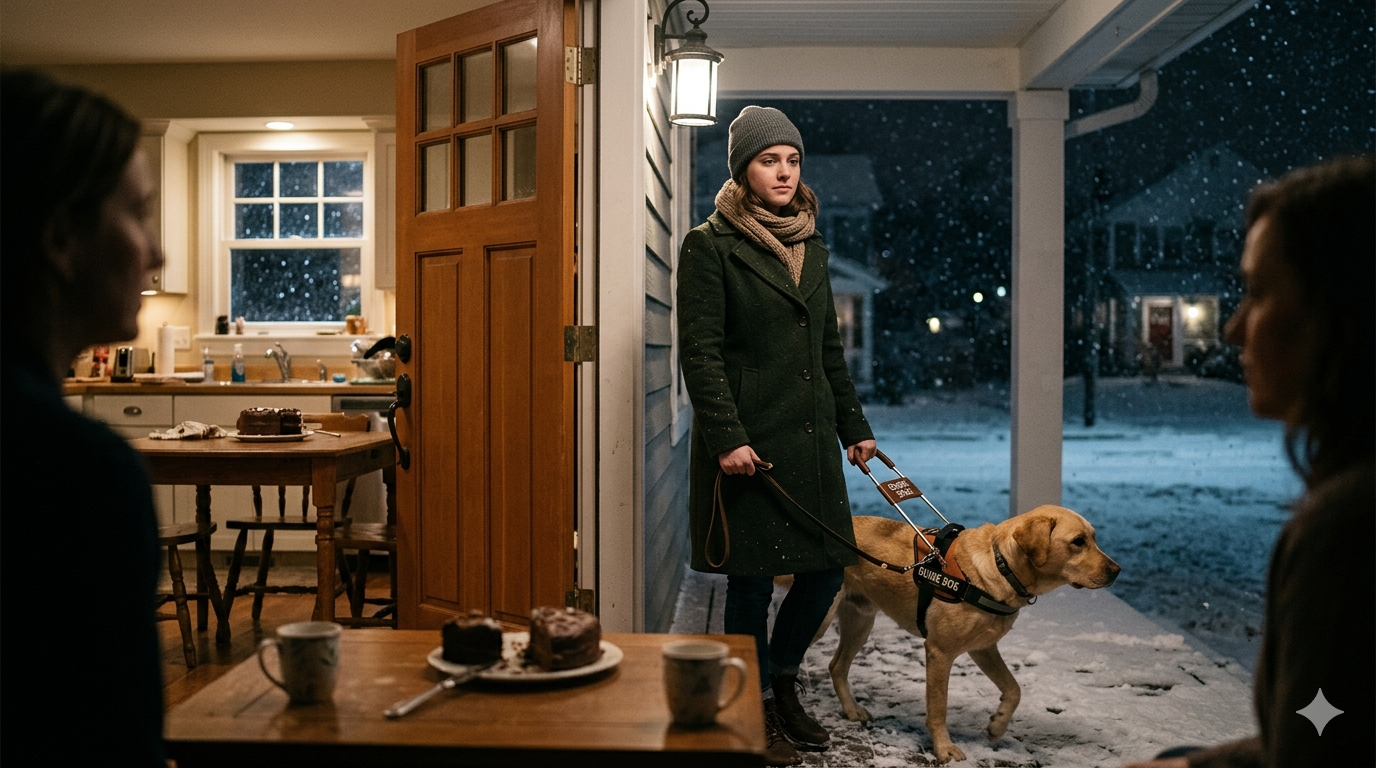
Zoey yawned for probably the tenth time in the past three minutes. It was snowing outside. Though she was sitting right by the heater, Zoey could still feel the cold seep in from the kitchen window that never quite closed properly. She would have to tell Mrs. Sands, the landlady, about it. Too bad she kept forgetting when it was warm, and when it started to snow, Mrs. Sands would be on vacation.
Chip, Zoey’s guide dog, stirred in sleep at her feet. She rubbed his ears and he woke up, cocking his head to look up at her. “It’s okay, boy,” she said softly. Then she began scrolling through her phone calls, her messages, and her emails. There were no missed calls, unread messages, or unread mail. Her brother had not called, and it was now 11:55 PM on her birthday. He doesn’t have much time left, she told herself.
She looked at the fool-proof chocolate cake she baked. This was the first thing she ever made using the oven at 13, and it was on her brother’s birthday. Her brother had told her that it was his favorite food in the world, and ever since then she has baked this chocolate cake every year on both their birthdays—even after he went away to serve with the Navy.
Chip nudged her hand, and Zoey checked the time on her phone again. 11:58. “I just want to know that he is all right,” she said aloud to no one in particular, but Chip licked the back of her hand anyway.
Well, I guess I will go to bed; it’s much warmer when I close the door and snuggle under my blankets anyway, Zoey thought. Just as she was about to call Chip to go into the bedroom with her, someone knocked on the door. It wasn’t the tap-tap-tap-tap of a polite knock or the incessant pounding of her mom, but it was the rhythm of SOS in Morse Code.
“Who’s there?” Zoey called as loud as she could, but her thin voice was swallowed up by the sound of falling snow in the night. The person outside tapped the SOS signal again. Clearly it was someone who knew that she knew Morse Code. And that person was in trouble.
Zoey decided to take a chance. She tapped her thigh to get Chip to come and stand next to her, and together they headed for the door. She opened it just as the person on the other side started tapping the signal again, this time faster and harder, as if time was running out.
Zoey swung open the door. Immediately a gust of cold air rushed in, pushing her back a step. “Oh, I’m so glad you’re home,” the woman on the other side said. The woman’s voice was hoarse and choked, but Zoey could not mistake it. It was her sister-in-law, Marilyn.
“I’m so sorry to bother you so late, but may I come in?” Marilyn said, her voice hesitant. “Of course. What’s wrong, Marilyn?”
“Oh, I was coming over to see you when this drunk driver hit me, and now I am all scratched up. Do you have a first-aid kit?”
“Let me go get it!” Zoey pulled the door shut, rushed over to the kitchen, and got out the smooth rectangular box. “Do you want me to help you?” she asked, even though she had never helped bandage someone up before.
“No, it’s okay, I can take care of myself,” Marilyn said as she took the kit and rummaged through it for supplies. Zoey turned to make tea, listening carefully as Marilyn sat down. For some reason, Zoey felt the need to stay as quiet as she could. Don’t be paranoid, she told herself. This is Marilyn, you have known each other for the past three years!
Zoey poured two cups of tea and brought them over. “What happened? Why is my brother not with you?” Zoey asked.
“I really can’t talk about your brother,” Marilyn said, her voice breaking. She began to describe a side of Zoey’s brother that Zoey didn’t recognize—a story of anger and abuse. Marilyn showed Zoey her arms and neck, where Zoey felt the heat of bruises and the texture of scars.
Marilyn then handed Zoey a few items she had “grabbed by mistake”: her brother’s phone and pieces of torn Braille paper. As Zoey examined the phone and the letters, her confusion grew. The scent of her brother’s cologne was there, but so was the sharp, clinical smell of antiseptic and hospital corridors. The Braille paper felt wrong—it was smooth where it should have been marked by a slate and stylus.
The next morning, the inconsistencies piled up. Marilyn’s story about a “home office” dispute didn’t fit the brother Zoey knew. Her brother expressed love through his hands—he had spent years transcribing books into Braille for her. He wasn’t a man of violent hands, but a man of silent, dedicated service.
Zoey retreated to her room and called “A.L.,” the emergency contact her brother had given her from the Navy. Instead of speaking, she tapped out a Morse code sequence—the lifeboat number from her brother’s first ship. The man on the other end gasped. “Frederick, is that you?”
“I am Frederick’s sister, Zoey,” she replied. The truth began to pour out. A.L. promised to find him, revealing a secret Zoey hadn’t known: her brother had lost his own eyesight saving a comrade’s son.
Zoey walked back to the living room, her heart heavy but her mind clear. She looked at Marilyn, whose silence now spoke louder than her words. “My brother learned Braille so that he could talk to me,” Zoey said firmly. “He has always found a way to communicate his love, and he always will.”
Taking Chip’s leash, Zoey stepped out into the cold morning. She was shivering, but she was no longer lost. She had stepped into the truth, and she knew her brother would be found.
When Gerald Andersen learned that his favorite stationery store, the one he used to visit every Monday with his mother after school, was closing, he was reading the January 1980 issue of the National Geographic. The dog-eared pages and the margin notes showed that issue was beloved by both mother and son, for both of them had left their fingerprints and reflections within it.
Despite how much he enjoyed going down memory lane browsing through the magazine and seeing his mother’s notes, he knew he had to go to that store one more time in her memory. Walking sideways, Gerald squeezed himself between cabinets and bookshelves, stepped over boxes of old pictures, and finally reached the shelves where the magazine now belonged. With the meticulousness of a librarian, Gerald scanned the taped notes he put on the shelves until he found the section labeled National Geographic, 1980–1996. He nudged the February issue away from the wall and squeezed the magazine he was holding next to it. Turning around, he was about to walk out the door when he saw his wife, Sandra, watching him there.
He walked over to her, gave her a quick hug, and said, “I’m going out to visit the stationery store. It’ll be shuttered after today.”
“Drive safe, Gerald, and promise me that you’ll just get one thing.”
“I’ll try my best.”
After a twenty-minute drive, Gerald reached the stationery store and saw Jackie, the current owner, waving at him. “We got some really good deals for you, Gerald,” Jackie said when Gerald walked in.
“Won’t miss them for the world,” Gerald said, smiling.
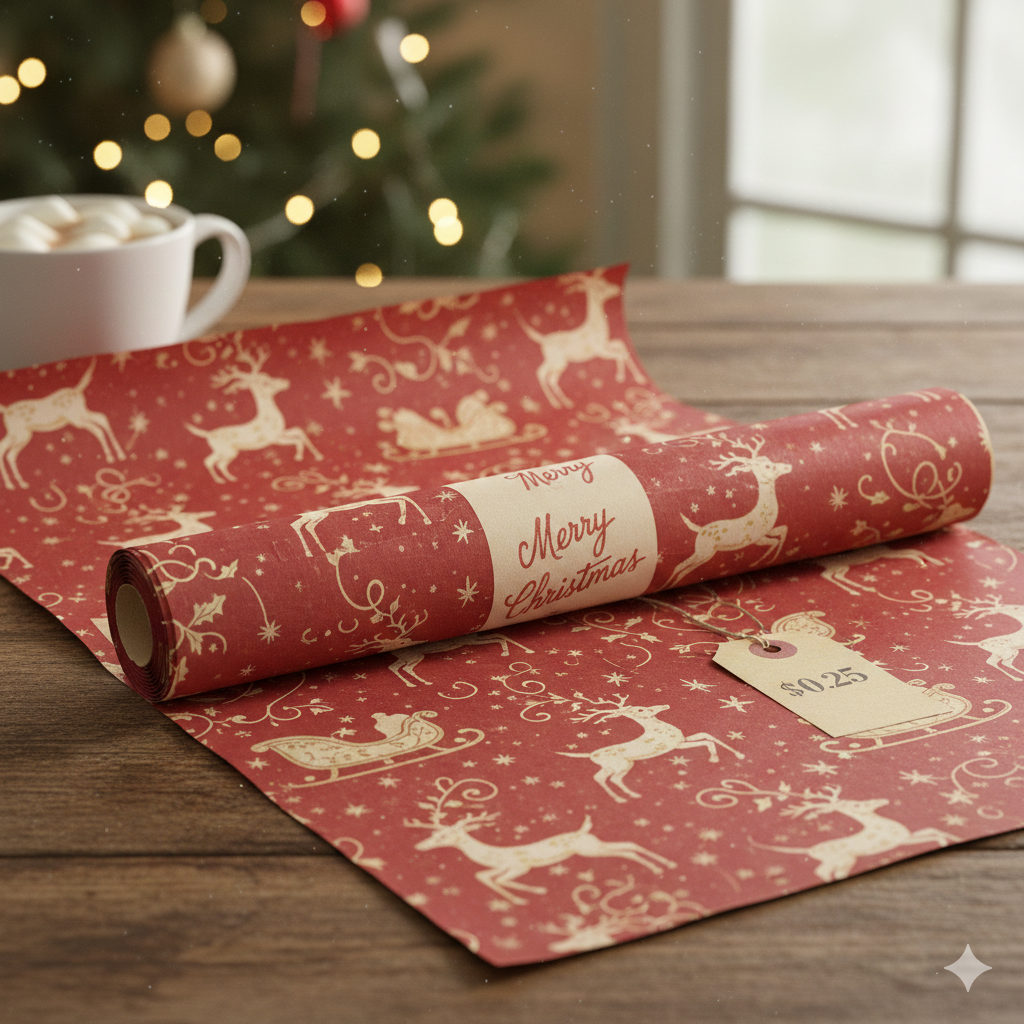
Gerald started shopping. The first thing that caught his eye was a stack of birthday cards. He remembered how he used to buy them with his mother to send to his friends, relatives, and eventually Sandra when they started dating. He decided to take the whole stack, thinking that he would eventually use them all. Gerald went to the pencils and pens section, where he bought his mother’s favorite ballpoint pens, multi-colored pens, a tin of pencils, and a couple of pencil sharpeners to go with them. After arming himself with all the pens and pencils he would need to write cards for the whole neighborhood the next five years, Gerald caught sight of a box of notebooks. “You can buy all of them for just $25,” Jackie called to him. Without hesitation, Gerald picked up the whole box. The last thing his mother used to shop with him was wrapping paper, for she loved giving away presents to her neighbors, church friends, and charities. He bought as many as he could hold. Just as the tin of pencils were teetering on top of the stack of notebooks, he saw a roll of vintage wrapping paper his mother used to buy to wrap presents for birthdays and Christmases. Gerald knew he must have it.
“Do you need a basket, Gerald?” Jackie asked, already bringing one over.
“You’re the best, Jackie,” Gerald replied, allowing the items to tumble from his arms into the basket Jackie held.
“I’ll miss you, Gerald,” Jackie said, chuckling. “You and your mother were always our favorite customers.”
After paying for everything, Gerald said his goodbyes to Jackie and drove directly to his storage unit. When he opened the door, cans of paint, which were stacked high on shelves, fell and started rolling out the door. Gerald scrambled to catch them, rearranged the shelves, and pushed them back, only to knock down another shelf containing his college textbooks. Sandra had packed this storage unit for him, and she had done a good job optimizing the space. After spending another ten minutes stacking, forcing, and rearranging, Gerald had to admit that the storage unit was one hundred percent full. He stepped out and closed the door. As he was putting all his purchases back into the trunk, Gerald felt nervous. He had no other option but to take the purchases home to Sandra, but he was afraid of how she would react. Would she be angry? Disappointed? Make him return everything? Yet these purchases were different — they were about honoring the memory of his late mother. Sandra had to understand. She always did.
When he arrived home, Sandra opened the door. Seeing the armfuls of stationery, her face turned white. “Gerald, I thought you were only going to buy one thing. What’s all this for?”
“I’m sorry, honey,” Gerald said, his voice squeaky with anxiety. “My mother loved that store, and these things were her favorites to buy.”
“We already have your mother’s couch, her books, her cookware, and her journals and photos. You can’t bring any more mementos into this house.”
“This,” Gerald said, hugging the vintage wrapping paper, “is what she used to wrap my gifts, your gifts, and all our friends’ and family’s Christmas and birthday gifts. We have to save it. We have to write on the paper our messages with the exact same stationery kit she used, so that we can keep her memory alive.” Gerald was about to take out the ballpoint pens to show Sandra the different colors his mother used to write different sections of a letter when she cut him off.
“Your mother is not in any of these things, Gerald. She’s gone!”
The cold truth hit Gerald like a knife through his heart. He picked up everything, pushed past Sandra, and ran into the spare room only to find that it was filled to the doorway with the furniture and keepsakes he had brought over from his mother’s house. Frustrated, Gerald ran into his and Sandra’s bedroom and slammed the door. He began to weep as he unrolled the vintage wrapping paper. Gerald started cutting pieces off to wrap imaginary gifts with them, and the act made him feel close to his mother again. However, after he had cried and pretended to wrap gifts for ten minutes, still surrounded by stationery that he knew he could not keep, he felt utterly alone.
At that moment, Sandra opened the door gently and stepped in. Ashamed of his pretend-play, Gerald turned to his wife and said, “I just don’t want to forget her!”
“I understand, Gerald. Do you know what this is?”
Gerald gasped as Sandra took from her cardigan pocket a birthday card he had written and illustrated for her fifteen years ago. “I didn’t know you still had it!”
“I understand saving things that matter too, Gerald,” she said. “Your mother was a generous person, a voracious reader, and a great writer, so I’m glad we have her books and journals. But what do you think she would want you to do with all these?” She gestured to the stationery strewn on the floor.
Gerald looked at the pencils and pens he would have used to do his homework with his mother. They were the same brand, but they looked too new. He then examined the notebooks — unused, blank, free from the past and full of possibilities for the future. Finally, he touched the rolls and rolls of wrapping paper he had bought and knew that they were not meant to sit rolled up in his house. His mother used to say that the Lord had blessed him so that he could bless others. Well, what if the things he bought could give less fortunate children a future, just as their predecessors had done for him?
“I think we can go on a date tonight, Sandra.”
“To where?”
“Well, I have lots of gifts to give out, and I want you to join me.”
“Of course, Gerald,” Sandra said, her voice shaking as she dabbed tears from her eyes.
Taryn checked the clock, 4:20 PM. her boss said that she could leave 30 minutes early for her birthday, so she spent the last 10 minutes checking her email to make sure that she has 0 unanswered messages, checked to see that her todo list was clear, and tidied up her desk. As she opened the first drawer, a curious yellow glow caught her eye. Peering into the back of her drawer, she saw that the light was emitted by the crystal ball her father gave her eighteen years ago. The compass on the crystal ball was pointing south, while the orb vibrated softly. “If you ever see the crystal ball glowing,” her father had said, “you must drop everything and follow the compass. I promise, it will take you to safety.”
Since Taryn was going south of the office to dinner with her friends anyway, she thought she would take the crystal ball with her. Just to be safe, she thought, although I cannot imagine being in any danger going to my favorite restaurant with my friends. It sure seems safer than living with parents who could leave you at any time!
When her mother disappeared eighteen years ago, Taryn’s father had given her the crystal ball with the instructions, promising to come home immediately upon finding her mother. He then dropped Taryn off to live with Grandma, a former military sergeant who was clean, hard-working, and strict. Since both Taryn’s parents were writers who had friends over all hours of the night, it took her a whole year to adapt to Grandma’s punctual, organized, no-nonsense way of life. Every day that year, she would check the crystal ball for a glow, waiting for the call to adventure. Yet never once did any light emit from the sphere, and the compass on it stayed still.
Eventually, she gave up waiting and adapted to her new way of life. Under Grandma’s discipline, Taryn turned from being a lackluster student into someone who got straight A’s in school, played in the orchestra, and was president of one club or another in high school. When Taryn majored in English in college, Grandma made sure that she had an internship every summer, and she received a full-time job offer a year before she graduated. With Grandma’s help, Taryn left the chaotic life of her childhood behind to work a stable job as an executive assistant, receiving employee of the month once a year for the past six years. She was not about to let the crystal ball disrupt her curated life.
When Taryn had driven about a mile away from her office, her phone rang. Yet she almost missed it, because a woman in a white car was screaming at her toddler, who was running around in the busy street. As cars swerved left and right to avoid hitting the little girl, she was making her way toward Taryn’s car, apparently attracted by the giant teddy bear sitting next to Taryn on the front seat. Taryn was about to take out her phone to call the police when she saw that the CTO of one of their largest customers was calling her. She picked up.
“Hello!”
“Hello Taryn? I’m calling because we want to make you an offer. Hello, can you hear me?”
Taryn could not respond, for at that moment a horn blared as a truck nearly slammed into Taryn’s car trying to avoid hitting the child. By now the little girl had reached Taryn’s car, and Taryn knew that she had to get involved. Unlocking her car doors, Taryn clambered to the other side and opened the door to let the child in. Upon entering Taryn’s car, the little girl immediately wrapped her arms around the teddy bear and squealed with delight. Taryn barely managed to close the door and climb back to the driver’s side before the light changed and she had to start driving. After having driven for a few blocks, she finally found a safe spot to pull over and wait for the child’s mother. Soon the mother pulled up, thanked Taryn, and disentangled the child from the teddy bear and got into their car. Watching the mother and child drive away, Taryn felt a sense of longing for her own mother, yearning to hug her once again. Yet she quickly pushed the feeling away.
Only then did Taryn remember the call. As she picked up her phone, she saw an email from HR, sent at 5:00 PM. “Due to recent performance concerns, we have decided to postpone your promotion review.” She had no idea that she was being put up for promotion. Yet, even more upsetting for Taryn was when she saw the three missed calls from the CTO and a voicemail. For 1247 days, as marked on her executive assistant dashboard, Taryn has had no missed calls. Now, she has dropped from being first in the leaderboard for number of days without missed calls to becoming last, settling right behind the new executive assistant Josh who had his first no-missed-call day today. Taryn began to cry.
When Taryn was parking, she felt the crystal ball vibrating violently. “Stop it,” she said to it, annoyed. “Now’s not the time to tell me to leave the restaurant!”
Her friends had all arrived when Taryn walked into the restaurant, flustered. She checked her phone and realized that she was fifteen minutes late!
“Taryn, are you okay?” her sharp-eyed best friend Mina asked, concerned.
“I’m fine,” Taryn said weakly, knowing full well that no one believed her. Because Taryn would be ten minutes early to wherever she went, her friends surprised her by all coming fifteen minutes early, to order Taryn’s favorite dishes and wait for her. Therefore, when Taryn came, the food had all arrived on the table, getting cold.
After dinner, her friends presented Taryn with a photo album. It contained 28 photos, one from each year of her life. When Taryn came to the last page, she was surprised to find not a photo but a sealed envelope.
“Who is this from?” She asked.
“Your grandma,” Mina said. “Did you think it was a secret lover?”
Taryn blushed. Of all her friends, she was the only one who has never dated before, and she had no intention of opening herself up to the ambiguity of a relationship. As she tore the envelope open, she gasped. The handwriting was her mother’s, she could recognize the flowing script anywhere.
Dearest Taryn, We’re in trouble. The mission went wrong. Your father’s crystal ball will keep you safe if you stay home. But if you want to save us, you’ll have to ignore it and come anyway. We won’t blame you either way. Love, Mom
Taryn stared at the address, they were somewhere in Africa! She thought about how quickly her life had unraveled today, from being the executive assistant most likely to get employee of the month to becoming last in line for a promotion. Yet she has saved a child, and the little girl’s delightful squeal and the mother’s gratitude have to mean more than losing her reputation at work. And oh, how she would give anything to be hugged by her parents again!
“Do you want to take the food home? Save yourself some cooking?” Mina asked, bringing Taryn back to the present.
“No, why don’t you all take the food. I’m getting on a plane tonight,” Taryn replied.
“Catch!” a boy sneered as the basketball sailed from his hand toward Bert’s head. Before Bert could drop his support cane to block the ball, it hit him and he fell. Several boys laughed. Painfully, Bert retrieved his cane and raised himself up, kicking the ball away from him.
As Bert started walking toward Jim’s direction, Jim quickly turned away and ran into the nearest bathroom. He did not want Bert to know that he saw everything.
Soon, though, Jim heard the tap tap of Bert’s cane as he made his way into the bathroom. Jim slipped into a stall. Through the door, He could hear running water as Bert washed his face with one hand, supporting himself stiffly with the other. Despite Jim trying his hardest to stay quiet, his throat was itchy and he coughed aloud.
“Jim, is that you?” Bert asked.
Jim stayed silent, and soon Bert opened the door and left.
Jim and Bert had been best friends ever since they were five years old. Bert had spastic cerebral palsy, which made his left side stiff. Yet he was good at video games, and they would play together every afternoon. In elementary school, Jim was Bert’s only friend, and they had all their classes together. Every year, Bert would save up his allowance for four months to buy Jim a birthday present. Whether it was a new game or some gaming equipment, Bert seemed always able to know exactly what Jim wanted.
Now that they were in middle school, though, Jim found himself wanting different friends. To his delight, he made it into the junior varsity team, and afternoons were now taken up by basketball practice. Despite how hard Jim tried to be sad that he could not play video games with Bert anymore, he was quite excited about his new status as a school athlete—until he saw how he and his teammates treated Bert just now. Let’s get back to practice, he told himself, shoving aside his shame.
When practice ended, Jim walked home and found that Bert was not waiting for him as usual. For a moment he thought he would go to Bert’s house and apologize. Yet Jim procrastinated, telling himself that it would be better for him to wait till morning, when he would have a better idea of what to say.
The next morning, Jim got up early and wrote a note of apology to Bert. He waited outside Bert’s house for half an hour, his gaze rarely leaving the door. Finally, Bert’s mom saw him and came out. She told him that Bert went to school early for peer listener training. Since Bert would be meeting with students after school, they could probably walk home together. Jim thanked her and walked to school, alone.
Jim did not have any classes with Bert that morning. Despite how hard he tried to concentrate on what his teachers were saying, his mind kept rehearsing how he would approach Bert and hand him the note at lunch. Finally, the long-awaited time came. After grabbing his lunch from his locker, Jim walked toward the table he and Bert usually shared only to find that a girl named Sasha, another peer listener, had taken his place. Sasha and Bert were talking and laughing. As Jim hesitated, thinking about how he could approach them, he saw the teammates who teased Bert also walking toward their table.
“So now you have a girlfriend, Bertie?” a boy named Bobby said.
“You leave him alone,” Sasha said firmly. The boy was taken aback by her confidence, but then he said, “Don’t sit with this loser who can’t catch a ball. Sit with us, pretty girl!”
“Leave them alone, Bobby!” Jim ran up and said. “They are my friends. Everyone has different strengths. I bet Bert can beat you in video games every time. You want to play against him?”
Bobby blushed, for he has heard that Bert was a gaming legend in their school. Just then, Mrs. Chesterson, the principal and Bobby’s aunt, looked over and said, “Bobby, is something going on that I should be worried about?”
“No ,” Bobby said quickly. “We were just talking. I’ll see you at practice, Jim!” As Bobby and his friends walked away, Mrs. Chesterson’s stare never left them until they sat down at a table far away from Bert.
Jim joined Sasha and Bert and slipped Bert his note. Bert read it quickly and said, “It’s okay, man, I forgive you. Hey, you want to try out a new game this afternoon? We can meet at your house after practice.” Jim nodded, eyes glistening. He felt a weight lift off his chest and realized that he truly had the best, most loyal friend in the world.
Finn slammed his phone onto the table and immediately regretted it. Even though he just got his one thousandth job application rejection letter, he also only had that much money in the bank. This meant that, no matter how frustrated he felt, Finn could not afford to replace his phone. After getting laid off a year ago, Finn had been applying to jobs nonstop, but finding nothing. He even started a business selling websites a few months ago, but he could not manage to get many clients. Every day he felt purposeless and useless, and the uncertain future scared him.
Finn decided to drive around to clear his head. As he was cruising on Good Hope Road, a sign in front of a house caught his eye.
LOST DOG, ONE THOUSAND DOLLARS REWARD FOR ANYONE WHO finds my GOLDEN RETRIEVER Charley!
With one thousand dollars, Finn thought, I could pay my rent with some left over. Well, I guess today I have a purpose. Here I come, Charley!
As Finn continued to drive on Good Hope Road, which intersected with Joy Avenue, he saw a girl standing by the road. She was frantically waving at passing cars, trying to get someone to stop and pull over. No one seemed to want to, though, and Finn soon found out why. As he stopped at the traffic light, he got to take a closer look at the girl. She had a black eye, a couple bruises on her face, and a lump on her forehead. She looked bedraggled and tired, her clothes had food stains on them, and her hair was tangled and flying every which way. Fearing that the girl might be on drugs, Finn quickly looked away, turning the opposite direction onto Voyager Street as soon as the light changed.
Voyager was a windy, residential street. It intersected with many small streets at strange angles. Finn had to constantly compare his surroundings with the map on his phone to ensure that he was heading the right direction. Finn hoped that Voyager Street would eventually snake its way back to Good Hope Road so that he could continue searching for Charley. Unfortunately, the street soon reached a dead end, and Finn saw that both the gas in his car and the battery on his phone were running low. Instead of turning back, though, Finn parked his car and got out. He started going from house to house, knocking on doors to see if anyone saw Charley. Yet not one person would answer his knock, and soon Finn found himself hopelessly lost.
Finn was standing in a courtyard, with houses on either side. Suddenly, a teenage boy jumped out from the bushes, followed by two ferocious-looking dogs. Finn was about to walk away when the boy kicked him hard in the groin, causing Finn to double over. As he fell, Finn’s phone dropped out of his hand, and the boy quickly took it. Ignoring his pain, Finn shouted, “Give back my phone!” and got up to chase the thief.
Finn was glad that he had been running every day since his layoff, for the boy was tireless. After flying down Voyager Street, he wound his way through Thimble Avenue and dashed down Thorns Lane. In his recklessness the boy tripped over a branch and fell headlong into a garden of roses, crying in pain as the thorns pricked him. Finn took the moment to rush ahead, jump on top of the ry, and snatched his phone back from the thief. He quickly snapped a picture of the boy, who was beginning to get up from his thorny bed.
“Who are you and why did you take my phone?” Finn said.
“Because I can,” the boy said menacingly, and gave a command to his two ferocious companions. The two dogs reared up on their hind legs, growling at Finn. “Give back the phone, or I will let them loose on you.”
Though Finn did not much care for dogs, he hated to see these two dogs being trained to attack people. Taking out a pack of beef jerky from his pocket, Finn gave some to the two dogs and they instantly became friends with him. Instead of staying with their owner, the two ferocious dogs began following Finn, nuzzling him for more jerky. Finn laughed in triumph, while the boy cried uselessly to the dogs, “Attack! Attack!”
After giving the dogs the last of his beef jerky, Finn walked back up Thorns Lane to Thimble Avenue. Using the last 2% of the remaining battery in his phone, he used an app to help him find his car. After stumbling up and down Voyager for half an hour, Finn finally saw it. He knew he had no choice but to follow the road back toward Joy Avenue, where the girl stood.
When Finn reached Joy Avenue, he found that the girl was still there waving at cars. He rolled down his window and called, “Hey, do you need help?”
The smile that spread across her face was so filled with joy and gratitude that Finn felt a knot of guilt in his heart for refusing to help earlier. To Finn’s surprise, the girl was also now petting a dog who seemed as unkempt as her, with matted fur caked with dirt. Finn shuddered at the thought of admitting this dog into his car. However, after taking a closer look at his own disheveled appearance and another at the girl’s joyful smile, that thought melted away too.
“What is the dog’s name?”
“This is Charley. I am Amelia. He is like me in that we both got lost.”
“Charley!” Finn said incredulously. “Did you know that there is a reward for Charley?”
Amelia and Charley got into the car. Amelia looked confused for a moment, but then said, “No. How much?”
“one thousand for the person who finds him.”
“One thousand would pay my rent and some more,” Amelia said. “I am about to be evicted from my place because I haven’t been able to pay rent for a couple of months. Last night I also got robbed and lost my phone and wallet. But you helped me. Do you mind sharing the reward?”
“Not at all, if it keeps both of us from being homeless. And I also think I know who robbed you.”
“A boy, about fifteen, with two ferocious dogs?”
“Yes. The dogs are all right, but we must report the thief to the police before he hurts anyone else.”
As they reached Charley’s house, the dog began panting in the car with excitement. He knew that he was finally home.
When Finn knocked on the door this time, it was answered immediately. The man who opened the door was wearing a police uniform and chomping down on a fig bar. “Oh Charley, where have you been buddy!” he said as soon as he saw his dog, who jumped onto his chest.
“Thank you both so much,” he said after a while of happy reunion, “for bringing my boy back. I have the check ready for you.”
“We also want to report two robberies,” Finn said. He and Amelia then gave the officer all the details of how they were each mugged. “I know the boy,” the officer said after taking a look at the picture. “I am his probation officer. We’ll get everything taken care of, and you will be sure to get your phone and wallet back, young lady.” Amelia and Finn both nodded thanked the officer, satisfied.
In this way, Finn, Amelia and Charley all found their homes, and a thief was caught. Finn accomplished his purpose for the day.
Tina stares listlessly out the window on a cloudy morning.
Tina looked out the window and sighed. Heavy clouds hung over the sky like a cold, wet blanket. She checked the weather on her phone and confirmed her suspicions, the entire day would be mostly cloudy.
Just when she was about to put her phone away, it rang.
“Tina, hey, happy birthday,” Angela said in her hoarse morning voice.
“What’s going on?” Tina ask, already knowing the answer.
“We’re so sorry,” Angela said. “I think we have to cancel sunbathing today, as it’s very cloudy. I’m not feeling so well, and Iva just had something come up. Natalie says it’s too cold, and you know she catches every cold and flu that comes around.”
“Of course,” Tina said without much emotion. “I should have guessed.”
“We’re so sorry,” Angela said again. “Let us know if you do decide to do something in the evening, we may be able to make it.”
“Yeah, sure,” Tina said. “I probably won’t be going anywhere in this weather. Hope you feel better soon, Angela.”
“Thanks!” Angela said brightly and hung up.
Tina hated how much the seasons affect her moods. When the sun was shining, she was bright and cheerful like Angela. But on a dreary, cloudy day like today, she found herself moping around her apartment, not getting much done at all besides holding a silly grudge against her friends for making her spend this birthday alone. For the next hour, Tina found herself scrolling on her phone, looking at friends’ parenting pictures and feeling behind in life. She then put on a playlist of mellow, moody music. As the melody alternated between high and low notes, Tina allowed her mind to ruminate over all the activities she could not do when the sun was behind clouds. She gradually drifted off to sleep.
Tina started awake when she heard her dog Eager barking for his breakfast. Her mom was also calling, for her phone was ringing with her mom’s infamous ringtone—a recording of her mom singing “Mom is calling you”. Tina determined that one of her to-do list items today would be to change her mom’s ringtone, which has turned heads at the office for more times than she could count.
“Hi sweetheart,” her mom said in her most cheery, singsong voice. “Happy Birthday! How is sunbathing?”
“You know there’s no sun, mom,” Tina said, a little frustrated. “It was canceled, nobody except I could make it. Not even the sun made it.”
Tina’s mom laughed. “Well, your dad and I are thinking of taking you to lunch. Can you make it?”
Tina hesitated. Lunch with her parents was not on her schedule today, and going out in such weather felt to her like pulling teeth. She also knew that her mom had more in mind than just taking her out to lunch. Yet, she really had nothing planned, and doing something with her parents was better than doing nothing at all.
“Well, honey, I thought it would be good for you and Eager to visit the homeless shelter with me afterward,” mom added. “It is always more blessed to give than to receive. Also, greeting the less fortunate would be a good experience for Eager.”
But who’s giving me _my gift? Tina thought to herself. Out loud, though, she said to her mom, “Sure, mom, let’s do it!”
After hanging up, Tina quickly took Eager out and fed him. “You’ll have an important mission, buddy,” she said to Eager as he gobbled up his breakfast. “We’re feeding the hungry.”
In less than 20 minutes, Tina’s parents were pulling up to her driveway. Eager thumped his tail and pawed the door as her parents walked up and called through the door, “Happy birthday, sweetheart!” Tina’s mom and dad each gave her a hug.
Although Tina expected that her mom would be bringing food and clothing for the homeless, she was still shocked by the mountains of shirts, dresses, and lunch boxes stacked in the trunk and on the back seat. She barely had room to squeeze herself onto the seat, and Eager curled himself into a tight ball on the floor.
Since retirement, Tina’s mom had been filling her days with charity work and serving at church. Tina and her brother knew to book time months in advance in order to celebrate her mom’s birthday. It was just like her mom to commemorate special occasions for the family, like Tina’s birthday, with charity work.
“Where would you like to go?” Tina’s dad asked as he started the car.
“Dad, you know I go to the same Italian restaurant every year,” Tina said.
“Yes, you have always prefer the familiar,” her dad said. “Why don’t my mom and I surprise you this year?”
“You know how I feel about surprises, dad. Remember the last time you tried to throw me a surprise party? You blind-folded me and we went to the restaurant, but it was closed.”
“Honey, that was ten years ago. Anyway, we’ll do whatever you want, it’s your birthday. Let’s go to the pizzeria.”
Tina and her parents sat at the same table they have always sat at since Tina started naming this restaurant to be her birthday go-to. They also ordered the same three dishes, eggplant parmesan, Hawaiian pizza, and seafood angel hair pasta. Everything tasted exactly as Tina expected them to taste, and she was happy. She wanted the moment to last as long as possible, before she was thrown into what she expected to be the chaos of the shelter. However, at one point the bill was paid, and they were off.
When they reached the shelter, Eager was the first to get out of the car. After stretching himself, Eager ran straight toward a yellow Labrador on the other side of the parking lot, dragging his leash behind him. He ignored all of Tina’s pleas for him to come back. Tina became even more embarrassed when she saw that the other dog was wearing a guide dog harness. “I’m so sorry,” she called to the guide dog handler as she ran after Eager.
“What is your dog’s name?” the handler asked, taking hold of Eager’s leash and commanding him to sit.
“This is Eager, and I am Tina,” Tina said, breathless.
“I am Andrea, and my guide here is Path,” the handler said. “Have you come to help pass out food to the homeless?”
“Yes, my mom bought tons of clothes too. Do you need any help getting to a station?”
“Yes please, and I would love it if we could partner together.”
“Of course,” Tina replied. She thought it would be wise to partner with someone more experienced in serving the homeless than herself.
Tina walked in front of Andrea with Eager, calling out directions as they walked toward one of the food stations. She saw that her mom was greeting everyone warmly, while dragging a mountain of clothes behind her. Her dad was holding a teetering stack of lunch boxes in his arms, and Tina felt nervous just watching him.
When they reached the station, Andrea expertly went behind the counter and took out a few bags of groceries. Then, she asked Tina to guide her while they passed out groceries and talked with other people. Tina found an older couple and Andrea offered them a bag of groceries. Each of them was holding a lunch box from Tina’s mom.
“Hey Andrea,” the woman said, “Good to see you. And are you Laura’s daughter?” she turned and asked Tina.
“Yes,” Tina said.
“Well, I just want you to know,” the man picked up, “that your mom makes the best sandwiches. That’s why I come here every Saturday!”
“James and Alyson used to be volunteer puppy raisers for guide dogs,” Andrea added, “before they lost their home. In fact, they raised my Path’s dad Duty.”
Tina felt a wave of compassion wash over her as she looked at the gaunt pair. Rmelessness can happen to anyone, she thought, even the kindest people.
After bidding the couple goodbye, Tina and Andrea continued to pass out bags of groceries. They talked to single mothers, young men and women who were couch surfers, former business owners and engineers, and a few children.
Then, somebody bumped into Tina, and Eager barked. His leash was snatched from Tina’s hand, and Tina was pushed and fell. Before Tina could recover, the person picked up Eager and ran.
“Hey!” shouted Tina indignantly. “Give him back!”
Andrea gave Path a command, and the guide dog team was off after the thief. As Andrea ran with Path, she kept shouting, “Stop him! Stop him!”
Who was this man, and why did he take Eager? These were the questions swimming inside Tina’s head, but she had no time to answer them. She ran on, shouting Eager’s name, ignoring the pain in her calves and the hoarseness in her voice. FINALLY, Andrea caught up to Eager and the thief, and she squirted something that made the man rub his eyes vigorously. Eager broke free from his grasp and ran toward Tina. Tina gave him a huge hug.
Someone must have called the police, for two cop cars pulled up and the thief was arrested. Before he got into the police vehicle, Tina got a chance to look at his face. This was Nimrod, who used to pull Tina’s hair and steal her hair ties when she was in elementary school. Tina hated him then, but now all she felt for him was sadness. The only way Nimrod chose to live was by destroying the happiness of others, and his philosophy has led him to homelessness and encounters with the police.
In late afternoon, as Tina walked back with Andrea, Path, and Eager, she felt a mixture of both fear and gratitude. From talking with the homeless to nearly losing her own dog, she learned that misfortune could happen to anyone.
When Tina and Andrea returned to the food station, Tina was surprised to see many streamers and balloons flying about. On one table someone has placed a large birthday cake. “Whose birthday are we celebrating?” she asked Andrea.
“yours! Happy birthday Tina!” After she said this, the whole shelter started singing “Happy Birthday”, and Tina’s face was flushed red.
“Oh, thank you, everyone! You really didn’t have to do this,” she said when she was asked to give a speech. “Mom was right, it is far better to give than to receive. I wasn’t sure if I even wanted to get out of my apartment this morning, but coming here to volunteer has made this the most unexpected and meaningful birthday in my life!” To this the crowd cheered.
When Tina got home, she realized that she no longer needed to play mellow music or mope around the house. Instead, she started rummaging through her pantry to find what she could cook, because she was going to make dinner for her best friends Angela, Iva, Natalie, and Andrea.